


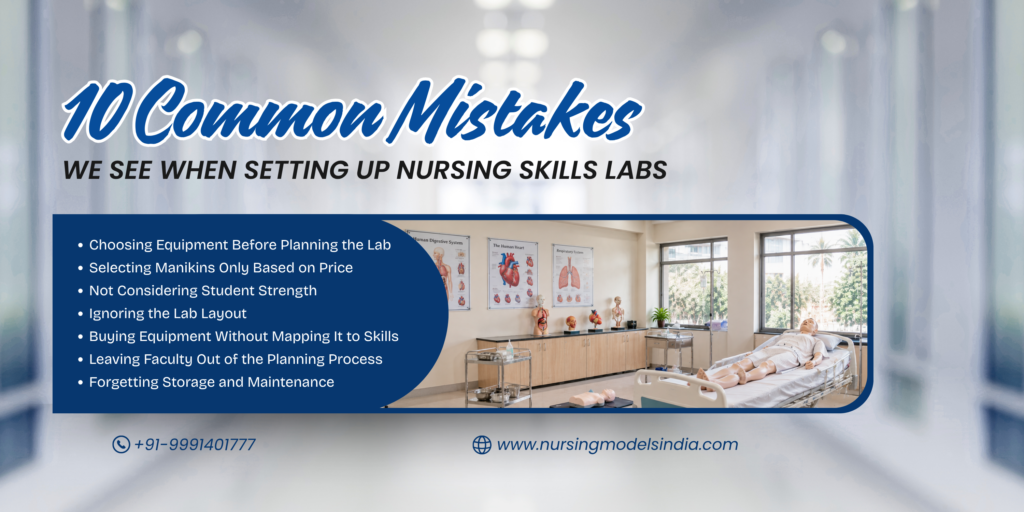
Nursing colleges across Maharashtra often encounter the same challenges when planning or upgrading their skills labs. From selecting Medical Training Manikins in Maharashtra without first assessing practical requirements to underestimating student capacity, overlooking lab layout, or failing to address faculty and storage needs, these mistakes can undermine the overall effectiveness of clinical training. Based on our experience working with nursing education institutions across Maharashtra, we have identified 10 common mistakes that colleges should consider before investing in a new nursing skills lab or upgrading an existing facility.
1. Choosing Equipment Before Planning the Lab
One of the first mistakes we see is finalising an equipment list before understanding how the available space will be used.
A nursing skills lab should be planned around student capacity, practical skills, faculty demonstrations, workstations, storage and movement. When equipment is purchased first, and the layout is considered later, colleges may find that the room becomes crowded or that frequently used equipment is difficult to access.
Before purchasing, we recommend measuring the room, understanding the expected student strength, and mapping the main clinical skills that will be practised.
2. Selecting Manikins Only Based on Price
Budget is naturally an important consideration for every nursing college. However, choosing a manikin simply because it has a lower purchase price can become a costly decision over time.
When comparing medical training manikins in Maharashtra, colleges should consider more than the initial price. Factors such as durability, supported procedures, realism, ease of cleaning, accessories, replacement parts, and long-term usability should also be evaluated.
From our experience, the right manikin is not necessarily the most expensive one. It is the one that matches the college’s learning objectives and can withstand regular student practice.
3. Not Considering Student Strength
A skills lab needs to work for the actual number of students who will use it.
For example, if a college has a large batch but only a few practice stations, students may spend more time waiting than practising. This reduces the effectiveness of hands-on learning.
Before finalising the setup, colleges should consider:
- Number of students per batch
- Practical group size
- Number of workstations
- Number of manikins
- Faculty availability
- Expected practice time
The objective should be to provide students with sufficient opportunities for active participation.
4. Ignoring the Lab Layout
Even high-quality equipment cannot compensate for an inefficient layout.
Workstations, nursing beds, manikins, storage units, demonstration areas, and other equipment should be positioned according to how students and faculty will actually use the room.
During our work with nursing institutions in Maharashtra, we have seen that every college has different space limitations. A layout that works for one institution may not work for another.
A good layout should provide clear movement, easy equipment access, adequate working space, and good visibility for faculty demonstrations.
5. Buying Equipment Without Mapping It to Skills
Another mistake is creating a long equipment list without first identifying the procedures students need to learn.
Instead of asking only, “What equipment should we buy?”, colleges should begin with:
What skills will students practise in this lab?
The equipment can then be mapped to those skills.
For example:
Clinical skill → Training requirement → Suitable manikin/equipment → Quantity
This approach helps colleges avoid purchasing equipment that is rarely used while ensuring that essential training requirements are covered.
6. Leaving Faculty Out of the Planning Process
Faculty members are among the most important users of a nursing skills lab, yet their input is sometimes considered too late.
Faculty can provide practical insight into:
- Frequently taught procedures
- Equipment requirements
- Demonstration methods
- Student assessment
- Storage needs
- Cleaning and handling
- Simulation requirements
We have found that involving faculty during the planning stage often helps identify practical issues before they become expensive changes after installation.
7. Forgetting Storage and Maintenance
A nursing lab can become difficult to manage when equipment has no proper storage system.
Manikins, accessories, consumables, PPE, and other training materials should have designated spaces. Equipment should also be stored according to the manufacturer’s handling recommendations.
Maintenance should be planned from the beginning. Regular cleaning, inspection, and proper handling can help keep training equipment ready for repeated use.
This is especially important when a college has multiple batches using the same equipment throughout the academic year.
8. Treating Simulation as an Extra Instead of a Learning Tool
Simulation can provide nursing students with a controlled environment in which they can practise procedures, communication and clinical decision-making before applying their skills in real clinical settings.
For colleges exploring simulation for nursing students in Maharashtra, the focus should not simply be on purchasing advanced simulation technology. The more important question is what students are expected to learn from the simulation.
Simulation activities can be designed around different learning objectives, including clinical procedures, patient assessment, emergency response, communication, teamwork and decision-making.
The technology should support the educational objective—not the other way around.
9. Not Planning for Future Growth
A nursing college’s requirements may change over time. Student intake can increase, new courses may be introduced, and teaching methods may evolve.
A lab designed only for today’s requirements can become difficult to expand later.
When planning a nursing skills lab in Maharashtra, colleges should consider whether the space can accommodate additional workstations, manikins, simulation equipment, storage, and technology in the future.
Planning for reasonable expansion at the beginning can reduce the need for major modifications later.
10. Assuming Installation Is the End of the Project
Delivering and installing equipment is only one part of a successful nursing lab project.
Faculty should understand how the equipment works and how manikins should be handled, cleaned, and stored. They should also know the purpose and correct use of different accessories.
Based on our experience, proper demonstration and handover can make a significant difference in how confidently faculty use the equipment.
For this reason, a complete project should ideally include installation, equipment demonstration, basic handling guidance, documentation, and handover.
Nursing Skills Lab Checklist for Colleges in Maharashtra
Before finalising a new nursing skills lab or upgrading an existing one, colleges can use this checklist:
- Assess current and expected student strength
- Measure the available room
- Plan the lab layout
- Identify required clinical skills
- Map equipment to learning objectives
- Select appropriate training manikins
- Plan sufficient practice stations
- Include faculty requirements
- Provide adequate storage
- Plan cleaning and maintenance
- Consider simulation requirements
- Allow room for future expansion
- Plan installation and faculty orientation
Final Thoughts
The 10 mistakes discussed above are often preventable with proper planning and practical guidance. Whether a nursing college in Maharashtra is establishing a new skills lab or upgrading an existing facility, decisions should be based on student requirements, curriculum, available space, and long-term usability.
Choosing the right medical training manikins in Maharashtra is only one part of the process. A successful nursing skills lab also requires the right layout, equipment mix, storage, maintenance plan, faculty involvement, and training approach.
For institutions considering simulation, equipment upgrades, or a complete nursing lab setup, starting with the learning objectives and working backwards toward the equipment and infrastructure can help create a more practical and sustainable training environment.