
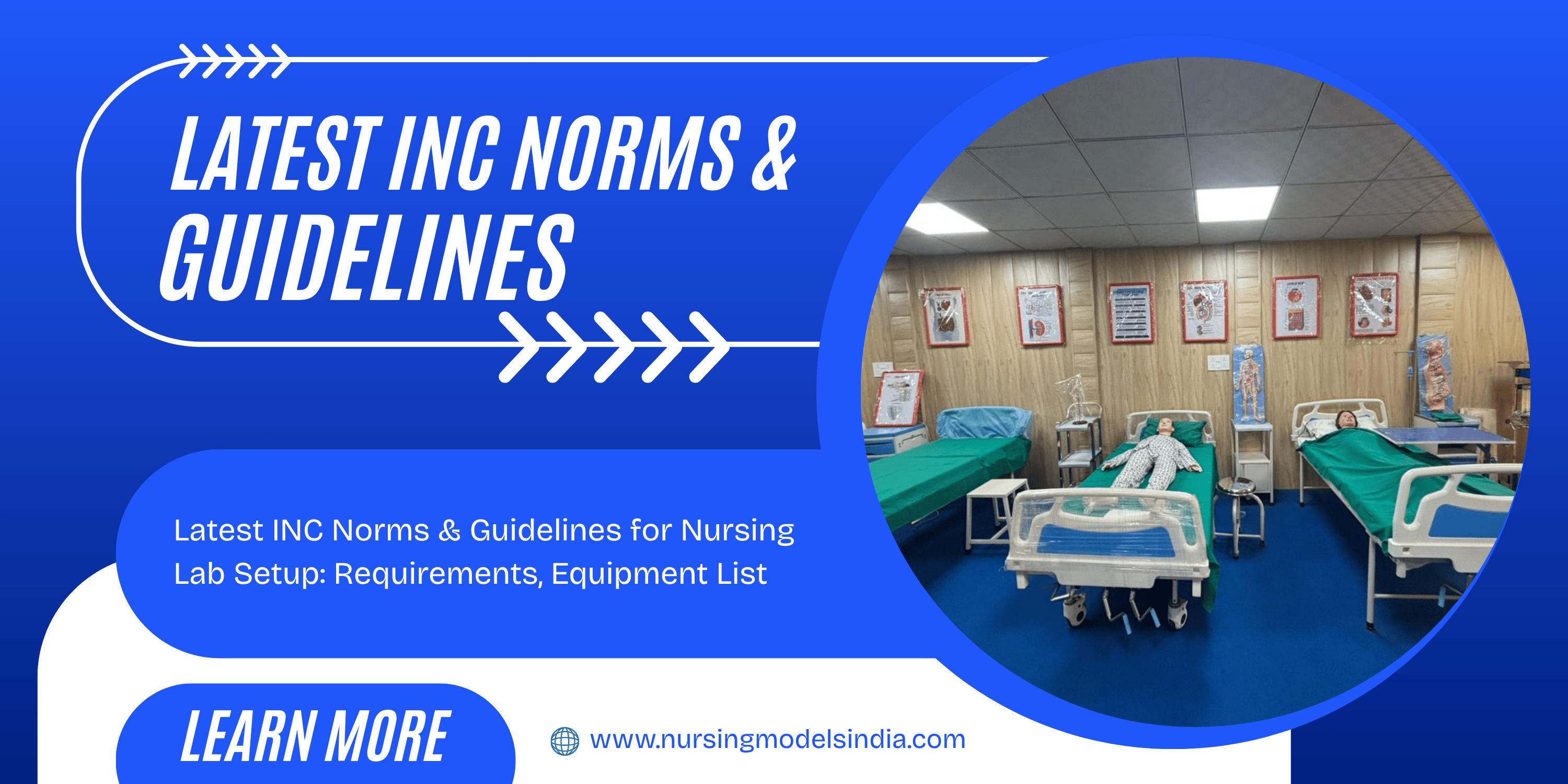
Setting up a nursing lab in India means following the standards set by the Indian Nursing Council. These rules make sure students get proper hands-on training in labs that are fully equipped and ready for real practice.
Even though there aren’t completely new rules for 2026, colleges still need to follow the latest INC Norms and Guidelines from recent years and focus more on modern training methods like simulation-based learning and better lab infrastructure. Understanding and applying these requirements is important to get approvals easily and stay compliant with the council norms.
Overview of INC Norms for Nursing Lab Setup
The Indian Nursing Council emphasizes practical, skill-based education. Nursing colleges must establish dedicated laboratories that simulate real clinical environments and support hands-on training.
Key focus areas include:
Functional and well-equipped labs
Adequate space based on student intake
Proper utilization of equipment during training
Safe and compliant infrastructure
Readiness for regular inspections
Institutions must ensure that all facilities meet the prescribed inc lab requirements to avoid delays in approval.
Mandatory Nursing Labs as per INC Guidelines
To meet inc norms & guidelines, the following laboratories are essential:
1. Nursing Foundation Lab
This is the primary training lab for basic nursing procedures.
Essential Equipment:
Adult mannequins (male and female)
Hospital beds with bedside lockers and screens
IV training arms and injection models
Catheterization and enema sets
Dressing and wound care models
Vital signs monitoring equipment
2. Community Health Nursing (CHN) Lab
This lab supports field-based and community healthcare training.
Includes:
Community health bags
Home visit kits
Sanitation and environmental models
Audio-visual education materials
3. Nutrition Lab
Used for diet planning and patient nutrition education.
Equipment:
Food models and charts
Measuring tools and utensils
Diet planning resources
4. OBG & Pediatric Nursing Lab
Focused on maternal and child healthcare training.
Key Equipment:
Obstetric delivery simulators
Pelvic models
Newborn and infant mannequins
Pediatric care training models
5. Pre-Clinical Science Lab
Builds foundational knowledge in anatomy and microbiology.
Includes:
Human skeleton models
Anatomical charts and organs
Microscopes and slides
Equipment Guidelines and Quantity Requirements
As per Indian Nursing Council norms:
Equipment must be adequate as per student strength
Students should get hands-on access during practical sessions
All items must be functional and well-maintained
Outdated or non-working equipment is not acceptable
Institutions are encouraged to adopt modern simulation tools to enhance learning outcomes and improve inspection performance.
Infrastructure Requirements for Nursing Labs
To meet inc lab requirements, colleges must ensure:
Proper lighting and ventilation
Safe electrical fittings
Clean water supply
Fire safety systems
Organized and accessible lab layout
Space Requirements
The INC does not prescribe fixed sizes for all institutions. Instead:
Lab space should be adequate based on student intake
Each lab must be separate and clearly designated
Overcrowding should be avoided
Hospital Attachment Requirements
Clinical training is a critical part of nursing education.
As per Indian Nursing Council:
Institutions must have access to a parent or affiliated hospital
Bed strength typically ranges between 100 to 300 beds, depending on the course (GNM/BSc) and intake
Hospitals must provide adequate clinical exposure to students
Relaxations may be considered for institutions in rural or underserved areas.
Lab Sharing Guidelines
Labs may be shared between programs such as GNM and BSc Nursing under certain conditions:
Labs must be located within the same campus/building
Equipment should be sufficient for total student strength
Proper scheduling must ensure equal access for all students
Simulation and Modern Training Practices
Although not mandatory in all cases, the Indian Nursing Council strongly encourages:
Use of advanced mannequins
Realistic clinical simulation setups
Skill-based training modules
Institutions adopting simulation-based learning are better prepared for inspections and deliver improved educational outcomes.
General Compliance Requirements
To fulfill inc norms and guidelines, institutions must also:
Conduct regular practical sessions
Maintain proper lab records and stock registers
Ensure faculty supervision during training
Keep equipment in working condition
Stay prepared for periodic inspections
Non-compliance may lead to rejection, penalties, or requirement of re-inspection.
INC Inspection Checklist
During inspections, the Indian Nursing Council evaluates:
Availability and condition of lab equipment
Adequacy of labs as per student intake
Actual usage of labs during training
Infrastructure and safety standards
Clinical exposure through hospital attachment
Proper planning and execution are crucial for successful approval.
Importance of Following INC Norms
Adhering to the lab requirements ensures:
High-quality nursing education
Better practical exposure for students
Smooth approval and renewal process
Strong institutional credibility
Colleges that strictly follow the Inc guidelines are more likely to succeed in inspections and attract more students.
Conclusion
The inc norms and guidelines for nursing lab setup are designed to create a strong foundation for clinical education. While the core regulations remain consistent, institutions are expected to enhance their facilities with better infrastructure, sufficient equipment, and practical training focus.
By aligning with the standards set by the Indian Nursing Council, nursing colleges can ensure compliance, improve training quality, and build long-term success in healthcare education.